key enabling TECHnologies and Smart environmenT in the Age of gReen economy.
Convergent innovations in the open space/building system for climaTe mitigation
RESEARCHING DIGITAL TECHNOLOGIES FOR THE CONSTRUCTION SECTOR
convergent innovations
climate mitigation
green economy
KETs-Key Enabling Technologies
Smart Environments
LATEST UPDATES
KETs-Key Enabling Technologies, Smart Environment
Pervasive Technology
Pervasive Technologies are computer systems integrated into daily life through objects with communication and computational capabilities. They create a global network within the Internet of Things (IoT), optimizing processes across sectors. These technologies impact production, consumption, and environmental management, facilitating eco-innovative practices in response to the challenge of climate change.
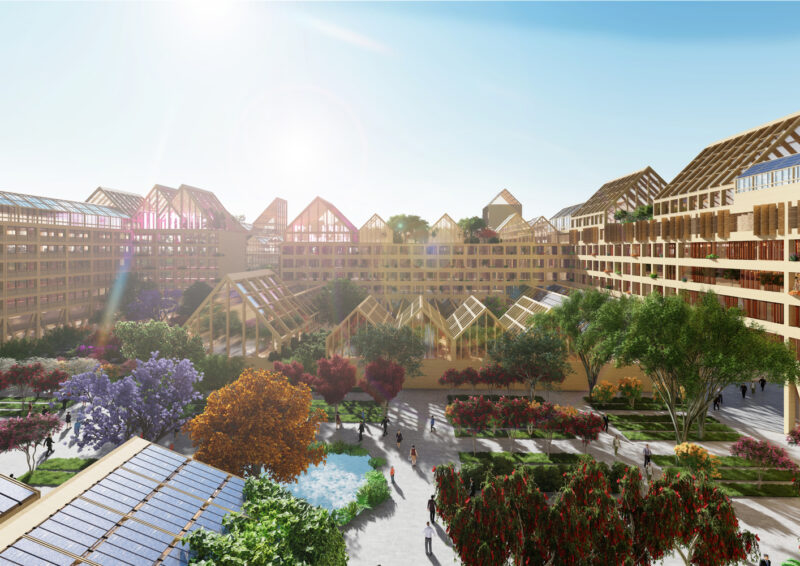
Emergent” dwelling represents an innovative habitat that copes with emergency, climatic and pathogenic scenarios, with scarcity of resources and environmental imbalances that require new lifestyles. The project is characterised by innovative solutions based on low-cost and low-tech technologies, aimed at energy and food self-sufficiency and the reduction of environmental impacts.
The socio-technical ecological system represents an analytical approach that focuses symmetrical attention on the social, environmental and technological dimensions of the built environment.
The project aims to make the dimension and complexity of a hyperobject, such as climate change, tangible, relatable, and communicable. Set in a hypothetical London of 2050, the project invites people to experience some extreme living conditions related to a mid-term climate scenario. Through an experimental approach, it seeks to develop methods and tools for adaptation, preparation, and survival in the face of climate hazards, food insecurity, and a regime of resource scarcity.
Self-Sufficient City for Post-Coronavirus China by Guallart Architects is a concept for housing development in a post pandemic era, which would be able to produce its own energy and food.
The design proposal us born from the need to provide solutions to the emerging crisis that are taking place on a world scale.
“Multigenerational and Age-Friendly Lifetime Home” in Marianella (Naples)
Within the project PRIN 2017-Tech-start, researchers of University of Naples Federico II (Department of Architecture) developed a methodological process for a climate proof intervention, applying the KETs for digital modelling, environmental control, and community engagement. The study explores the topics of Convergent Innovation to promote sustainable prosperity and universal health rights. A pilot project, the “Multigenerational and Age-Friendly Lifetime Home” in Marianella (Naples), pioneers innovative co-housing for seniors and university students, representing an experience in the field of the Emergent Dwelling with broad national innovation potential for forms of post-pandemic housing.